How Long Should You Journal Before Deciding Whether It Works?
Quick Answer: Give it four weeks of consistent writing before judging it, and expect to feel slightly worse in the first week or two rather than better. The research on expressive writing consistently shows short-term discomfort followed by improvements that appear weeks later — which means the moment most people quit is precisely the moment the evidence says to keep going.
What you measure matters as much as how long you wait.

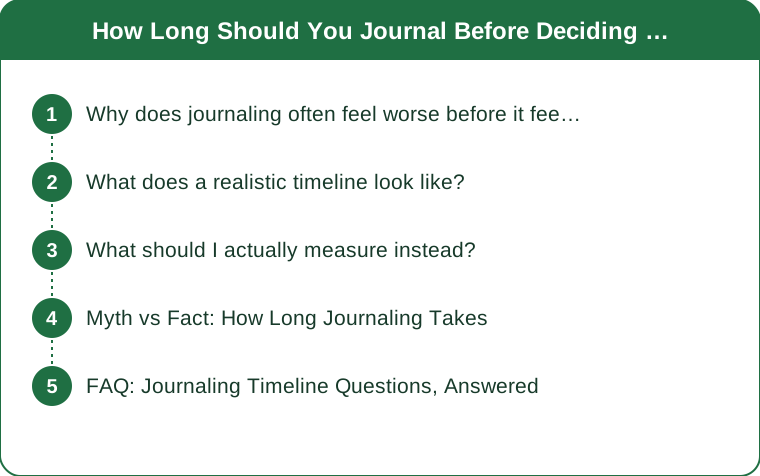
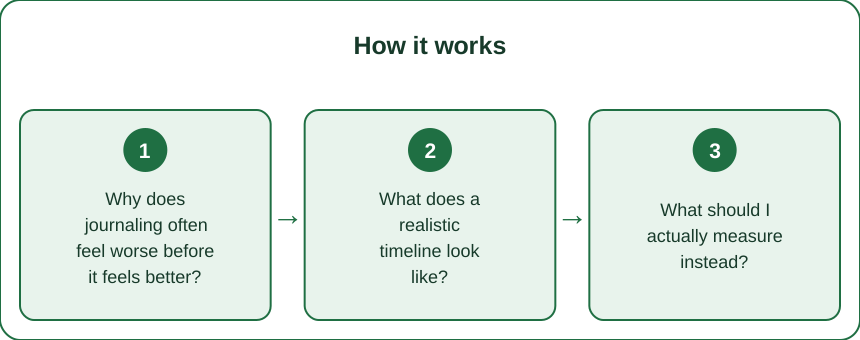
Why does journaling often feel worse before it feels better?
Writing about something difficult brings it into focus. You are deliberately turning attention toward material you have been managing by not looking at it, and that is uncomfortable by design rather than by accident.
The classic research pattern shows exactly this. Studies on expressive writing repeatedly find participants report worse mood immediately after sessions, with measurable improvements in wellbeing appearing weeks later.
Judging by how you feel at the end of a session is therefore the wrong measurement. It reliably points the wrong way in the early stage, which is why so many people conclude it does not suit them.
The discomfort should be decreasing, though. Writing about the same difficult thing should feel gradually less charged across several sessions. If it is getting more distressing rather than less, that is a signal to stop and talk to someone rather than to push on.
And there is a difference between processing and ruminating. Writing that moves — that adds context, changes perspective or reaches a new sentence — is doing the work. Writing that circles the same three sentences week after week is rehearsing rather than processing.
What does a realistic timeline look like?
Week one is the awkward one. You are learning what your own voice on paper sounds like, entries feel performed, and you will probably not enjoy it. This is normal and it is not a verdict.
Weeks two and three are where the habit either forms or does not. The novelty has gone and the benefits have not arrived yet, which is the hardest stretch of any new practice.
Around week four, most people notice something, usually not a dramatic mood change but a small shift — problems feeling more defined, reactions feeling slightly slower, a sense of having somewhere to put things.
By eight to twelve weeks you have enough entries to reread, and rereading is where a large share of the actual value lives. You cannot see a pattern in four entries.
Beyond three months the practice usually changes shape. People write less often and more purposefully, or shift format entirely, and that evolution is a sign it is working rather than fading.
And if twelve weeks of honest attempts produce nothing at all, that is a legitimate answer. Journaling is not universal, and stopping after a fair trial is a decision rather than a failure.

What should I actually measure instead?
Track whether you wrote, not how it felt. A simple tick on a calendar removes the daily judgement that kills the habit.
Notice the gap between event and reaction. One of the most commonly reported effects is a slightly longer pause before responding to things. It is subtle, it shows up around week three or four, and you will miss it if you are only watching mood.
Count how often you write about the same thing. A worry that appears in twelve consecutive entries and then stops appearing is a measurable result.
Reread month one at the end of month two. The distance is what makes the change visible; you cannot see it from inside the week.
Watch sleep, if you write in the evening. Many people find getting the day’s contents onto paper before bed measurably shortens how long they lie awake.
And ask a specific question rather than a general one. Do I feel better is unanswerable. Am I still turning this over at 11pm is answerable, and it is the kind of thing that actually changes.
Myth vs Fact: How Long Journaling Takes
Myth: If it were going to help, you would feel better after the first session. Fact: The most consistent finding in the research is short-term discomfort followed by delayed benefit. Immediate relief is a bonus, not the mechanism.
Myth: You have to write every day for it to count. Fact: Several of the most-cited studies used short protocols — a handful of sessions over consecutive days — and still found effects months later. Consistency helps; daily is not a requirement.
Myth: Longer entries work better. Fact: Depth beats length. Fifteen honest sentences do more than three pages of describing what happened, and very long entries are frequently avoidance dressed as effort.
Myth: If you miss a week, you have to start again. Fact: Nothing resets. Picking up after a gap and writing about the gap is often one of the more revealing entries you will produce.
Myth: It stops working once it becomes routine. Fact: It changes rather than stopping. Entries get shorter and more targeted, which reads like decline and is usually competence.
Myth: You need the right notebook, prompt or app first. Fact: These are the most common and most enjoyable forms of not starting. Any paper works, and week one is awkward regardless of what you write on.
FAQ: Journaling Timeline Questions, Answered
How many minutes per session is enough?
Ten to fifteen minutes of honest writing is a reasonable target and matches the length used in a lot of the research. Longer is not automatically better.
Should I keep going if it is making me more anxious?
If distress is increasing session over session rather than easing, pause the practice and speak to a professional. Writing is a good tool and it is not the right tool for everything.
Does typing count for the timeline?
Yes. Handwriting is slower and many people find it produces different content, but the evidence for benefit does not hinge on the medium. The one you will actually keep up is the right one.
TL;DR:
- Expect to feel slightly worse in weeks one and two — that is the documented pattern, not a bad sign.
- Give it four weeks before judging, and eight to twelve before you have enough to reread.
- Measure whether you wrote, whether the same worry keeps reappearing, and how long you lie awake.
- Depth beats length; ten to fifteen honest minutes is the working dose.
- Rising distress session over session means stop and talk to someone, not push harder.
Most people quit in week two. Week four is where it starts.
Keep Reading
This article is for general informational and styling purposes only. Fit, sizing, and product availability may vary.