Why Writing a Letter You Never Send Works Better Than Journaling
Quick Answer: An unsent letter forces you to organise your thoughts for a specific listener, which is a different cognitive task than journaling for yourself. Naming a reader requires you to sequence events, explain context and anticipate objections — the exact structuring work that expressive writing research links to reduced distress. Write it, never send it, and decide what to do with it after 24 hours, not before.
You have journalled about this for three weeks. The same situation, the same loops, and it has stopped moving.
Then somebody suggests writing a letter to the person involved — one you will never send — and forty minutes later something has genuinely shifted.
Same notebook. Same handwriting. The difference is that you were writing to somebody, and that changes almost everything about what your brain is doing.

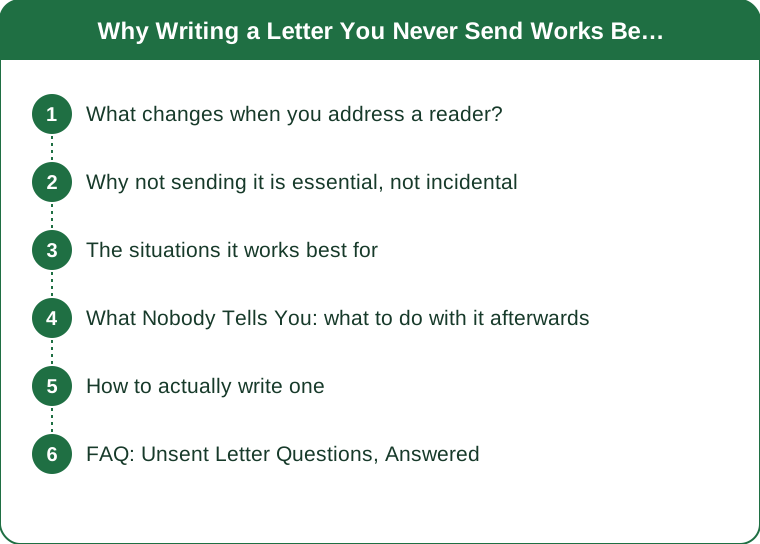
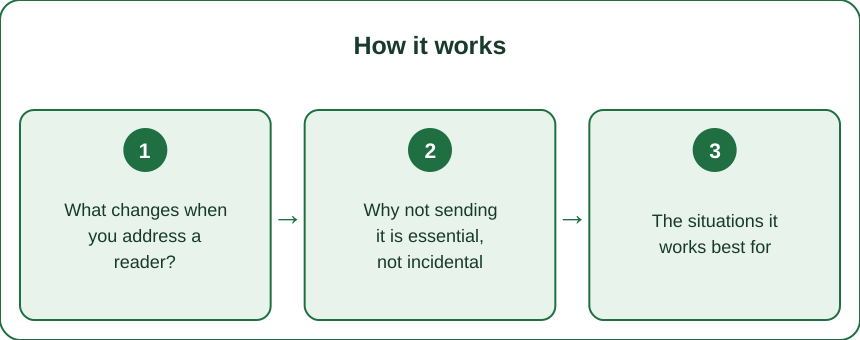
What changes when you address a reader?
Journaling for yourself allows fragments. You can write she was awful and move on, because you already know the context, the history and the tone of voice.
Writing to someone removes that shortcut. You have to say what happened, in what order, and why it mattered — because the reader, even an imagined one, does not have your internal footnotes.
That is the whole mechanism, and it is not a small one. The dominant explanation for why expressive writing helps is that it forces construction of a coherent narrative from experience that is otherwise stored as fragments of feeling. James Pennebaker’s research on expressive writing found the largest benefits in people whose writing became more structured and more causally explanatory across sessions.
An unsent letter enforces that structure by design. You cannot write an incoherent letter to someone; the format resists it.
The second change: addressing someone requires you to hold their perspective in mind, even while disagreeing with them. That is not forgiveness and it does not require it. It is simply a different cognitive posture from pure self-expression, and it tends to produce different insights.
Why not sending it is essential, not incidental
The unsent part is doing real work, and people who send the letter usually lose the benefit entirely.
Sending changes the audience mid-writing. The moment sending becomes possible, you start editing for consequences — softening, hedging, calculating how a phrase will land. That editing is the opposite of the honesty that makes the exercise useful.
Sending shifts the goal from understanding to persuasion. An unsent letter asks what happened and how do I feel about it. A sent letter asks how do I make them see it my way. The second is a legitimate goal and a completely different activity.
Sending outsources the resolution. If you send it, the outcome now depends on their response. The whole value of the unsent version is that it resolves inside you, where you actually have control.
The one rule that protects this: decide before you start that this will not be sent. Not probably. Definitely. That decision is what unlocks the honesty, and it has to be made in advance, not negotiated with yourself at the end.
The situations it works best for
Conflict that cannot be resolved. Someone who has died, someone you are no contact with, a former employer, a version of a person who no longer exists. Journaling about these tends to loop because there is no natural endpoint. A letter has one built in.
Anger you cannot express safely. Anger is famously difficult to journal about, because free writing about anger can rehearse and amplify it. A letter gives it a target and a shape, which tends to metabolise rather than magnify.
Gratitude you never expressed. A teacher, a grandparent, someone who helped once and never knew. This version is genuinely moving to write and among the most reported as beneficial.
Something you need to say to a past version of yourself. A letter to yourself at nineteen is one of the most reliably useful variants, and it works because it has all the same structural properties.
Where it works less well: ongoing daily stress, routine anxiety, or decisions you are actively making. Those need a different tool, because there is no single reader who makes sense.

What Nobody Tells You: what to do with it afterwards
This question causes more hesitation than the writing itself, and there is no universally right answer.
Keeping it. Some people file unsent letters and reread them a year later, and find the rereading is where the change becomes visible. This works well if you are someone who finds old entries useful rather than mortifying.
Destroying it. Burning or shredding it has a genuine ritual quality that a lot of people find valuable, and it removes the low-grade worry about someone finding it. If the letter is very angry, this is usually the better choice — an angry letter kept in a drawer can become something you return to and re-enter.
The 24-hour rule. Do not decide on the day you write it. Put it somewhere sealed, and choose after a day. What feels essential to keep at 11 p.m. often looks different on Tuesday morning, and vice versa.
One thing to avoid: typing it somewhere that syncs. An unsent letter in a cloud-synced notes app is a letter that exists on four devices and in a backup. Handwriting or a local file only. The privacy is part of what makes the honesty possible.
How to actually write one
Set a timer for 20 minutes and do not stop writing. Continuous writing bypasses the editing instinct, and the exercise loses most of its value if you are crafting sentences.
Start with Dear [name] and use it. The salutation is not a formality; it is the thing that activates the addressed-reader mode.
Write what happened first, feelings second. Counterintuitive, but narrative before emotion tends to produce better outcomes than the reverse. Say what occurred, in sequence, and let the feeling attach to the events.
Include the part you would never say. The pettiest, least defensible sentence. This is not something you would put in a sent letter, which is exactly why the unsent version can hold it.
End with what you wanted. Not what you want now — what you wanted at the time. That sentence is frequently where the whole thing resolves.
Do it three or four times, not once. The expressive writing protocol used in most research involves writing on three or four consecutive days, roughly 15 to 20 minutes each. Single sessions can feel worse rather than better, because you have opened something and not finished processing it. The improvement generally shows up across sessions.
This is general information, not therapy. If writing about an experience leaves you feeling significantly worse, or if the events involve trauma, working with a therapist is a better route than doing this alone.
FAQ: Unsent Letter Questions, Answered
What if I genuinely want to send it afterwards?
Write a completely new letter. Do not send the unsent one — it was written under different rules, with the safety of never being read. If after a week you still want to communicate, that is a real impulse worth honouring, and it deserves its own draft written for an actual reader.
Does typing work as well as handwriting?
Both work. Handwriting is slower, which some people find helpful because it keeps pace with thinking rather than outrunning it. The bigger factor is privacy — write wherever you will be most honest.
Can I write to someone who is still in my life?
Yes, and it is often the most useful version. Writing to your mother, your partner or your colleague clarifies what you actually want to say, which frequently makes the real conversation shorter and calmer. Just keep the letter and the conversation entirely separate.
TL;DR:
- Addressing a reader forces you to sequence events and explain causation — the narrative structuring that expressive writing research links to reduced distress.
- Deciding in advance that it will never be sent is what unlocks the honesty; the moment sending is possible, you start editing for consequences.
- It works best for unresolvable conflict, unsafe anger, unexpressed gratitude, and letters to your past self.
- Write continuously for 20 minutes, start with the salutation, put narrative before feeling, and include the sentence you would never say aloud.
- Wait 24 hours before deciding whether to keep or destroy it, and keep it off anything that syncs.
You have journalled about this enough. Try telling someone instead — and then not telling them.
Keep Reading
This article is for general informational and styling purposes only. Fit, sizing, and product availability may vary.