Why Rereading Old Entries Makes You Want to Stop Journaling
Quick Answer: People write more, and more honestly, when something is wrong. Contentment produces short entries or no entry at all. So a journal is a systematically biased archive weighted toward difficulty, and rereading it presents a version of your past that was genuinely harder than your past was. Add hindsight bias, which makes old worries look obvious and old decisions look foolish, and rereading becomes an exercise in feeling bad about a period you actually got through.
The journal is not lying. It is sampling badly, and it was never designed to be read the way you are reading it.

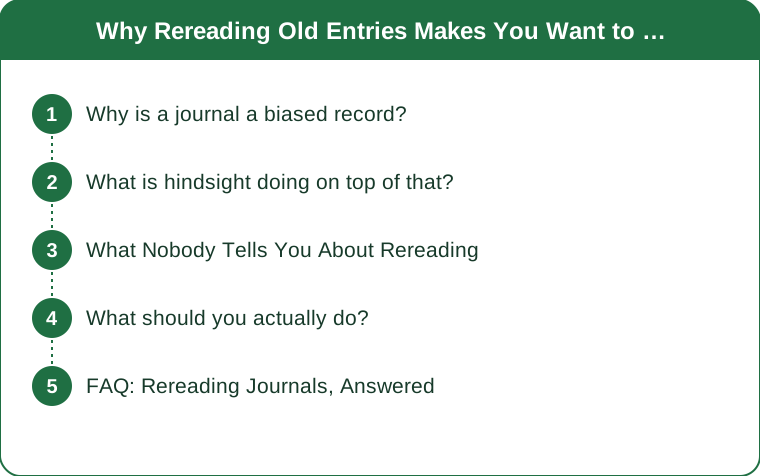
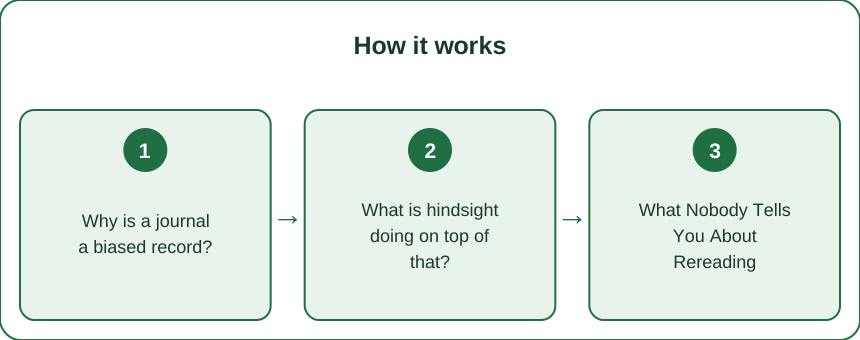
Why is a journal a biased record?
Because writing is effortful, and effort gets spent where there is pressure.
Difficulty generates a need to process. When something is confusing, painful or unresolved, writing helps, and people reach for the notebook. Contentment generates no such need. A good week produces a two-line entry or none, because there is nothing to work out.
The result is a systematic sampling bias. If you journal for a year, the entries will over-represent the hard weeks by a large margin, not because the year was hard but because the hard parts were the parts that got written down.
There is a second layer to it. Even within a difficult period, what gets written is the difficult content. The ordinary parts of a hard week, meals, work that went fine, a good conversation, do not make it onto the page, because the page is being used to process the problem.
So a rereading gives you: the hardest weeks, described in terms of their hardest content, with the surrounding context absent.
And the emotional response to that is entirely rational. It looks like a bleak year. It reads like a person struggling continuously. Neither is what happened.
A quick test: think of a genuinely good week from the last year. Now check whether there is a substantial entry for it. Usually there is not, and that absence is the whole phenomenon in one observation.
What is hindsight doing on top of that?
Making your past self look worse than they were, reliably and unavoidably.
Hindsight bias is the well-documented tendency to see past events as more predictable than they were once you know the outcome. Reading an entry where you agonised over a decision, knowing how it turned out, makes the agonising look excessive. It was not excessive at the time. You did not have the information you have now.
The related effect is outcome bias, judging the quality of a decision by its result rather than by the reasoning available at the time. Old journal entries are full of good decisions with bad outcomes and bad decisions with good outcomes, and rereading flattens all of them into looks obvious now.
And there is a specific one that hits journals hard: the fading affect bias. Negative emotions fade faster in memory than positive ones for most people, which is generally a helpful feature. But a journal preserves the negative emotion at full original intensity, in your own words. So rereading reintroduces an emotional state that your memory had appropriately softened, at its original strength, without the surrounding context that made it bearable.
That is why rereading a difficult entry can feel more raw than remembering the same period does. Your memory had done useful work, and the text undoes it.
None of this makes journaling harmful. The writing itself has good evidence behind it, particularly expressive writing about difficult experiences, which has been associated with improvements in wellbeing across a substantial literature. It is the rereading that carries the problem, and rereading is optional.

What Nobody Tells You About Rereading
Journaling advice is almost entirely about writing, and rereading is treated as an obvious bonus. It is not obvious and it is not automatically a bonus.
Here is what is rarely said: the value of journaling is in the writing, not in the archive. The mechanism proposed for the benefits of expressive writing is the act of organising an experience into language, which happens at the moment of writing. The resulting text is a by-product. Treating it as a document to be consulted misunderstands what produced the benefit.
Second thing: you can journal and never reread, and lose nothing. Plenty of long-term journalers do exactly this. Some burn or discard entries deliberately, which sounds dramatic and is a reasonable response to the recognition that the archive is not the point.
Third: if you do want to reread, the interval matters enormously. Rereading something from last month, when you are still close to the situation and the outcome is not yet clear, tends to be unpleasant and unhelpful. Rereading something from three or five years ago, far enough that the person writing feels slightly like someone else, is a completely different experience and is where the genuine perspective lives.
Fourth, and the practically useful one: you can fix the sampling bias by writing on the good days too. Not long entries. Three lines on an ordinary Tuesday when nothing is wrong. It feels pointless at the time and it is the entry that changes what the archive looks like in two years.
And fifth: noticing that rereading makes you feel worse is a useful observation, not a failure of the practice. It usually means the archive is doing exactly what an archive of processed difficulty would do.
What should you actually do?
Separate the writing from the reading, and default to not reading. Write for the benefit of writing. Treat rereading as an occasional deliberate activity rather than as part of the practice.
If you reread, choose the interval deliberately. Three years or more is where perspective lives. Under a year is usually too close.
Write on ordinary days. Three lines when nothing is happening. This is the single change that alters what your archive contains, and it takes ninety seconds.
Add a line about what was fine. Even in a difficult entry, one sentence about what was working. It costs nothing at the time and it is what your future self will need for context.
Keep a separate short log of things that went well. A running list, one line per entry, no elaboration. It is a completely different document from the journal and it corrects the bias without changing how you journal.
When you do reread, read for the reasoning, not the outcome. Ask what information the person writing had, rather than whether they were right. That single reframing removes most of the hindsight sting.
And stop rereading when it stops being useful. There is no obligation to finish a notebook, and closing it is a legitimate response rather than avoidance.
One caution worth stating: if rereading consistently triggers significant distress, or if journaling has become a way of repeatedly revisiting a difficult experience rather than processing it, that is worth raising with a therapist. Expressive writing helps most when it moves toward making sense of something; when it becomes rumination in written form, it can do the opposite. This is general information, not medical advice.
FAQ: Rereading Journals, Answered
Should I reread my journal at all?
Not necessarily. The benefit is in the writing. Rereading is optional and works best at long intervals.
How far back should I go?
Three years or more, where the writer feels sufficiently distant. Recent entries are too close for perspective and too raw for comfort.
Should I throw old journals away?
Some people do and find it freeing. Others keep them and never open them. Both are reasonable, and the decision is yours rather than a rule.
Why do I cringe reading my own writing?
Hindsight bias plus the ordinary discomfort of encountering an earlier version of yourself. It is nearly universal and it says little about the quality of what you wrote.
How do I make my journal more balanced?
Write on good days, briefly. Add one line about what was working to difficult entries. Both take under two minutes.
Is it bad that I only write when upset?
No, it is the normal pattern and it is why the archive skews. Knowing that is enough to prevent the rereading from misleading you.
TL;DR:
- Journals over-represent difficulty because difficulty is what motivates writing; good weeks go unrecorded.
- Within hard entries, the ordinary and functioning parts of life are missing too.
- Hindsight bias makes past worries look excessive and past decisions look obvious.
- The fading affect bias means your memory softened those feelings; the text restores them at full strength.
- The benefit of journaling is in the writing, not the archive, so rereading is optional.
- Write three lines on ordinary days, and reread at three years rather than three months.
You did not have a worse year than you remember. You have a record that only shows the hard parts.
Keep Reading
This article is for general informational and styling purposes only. Fit, sizing, and product availability may vary.