Bullet Points, Long-Form, or Prompts: Which Journaling Format Actually Sticks?
Quick Answer: No single journaling format is objectively best — bullet-style tracking sticks best for people who want quick daily consistency, long-form writing suits those processing complex thoughts, and prompted journaling works well for people who find a blank page intimidating. Matching format to your actual reason for journaling predicts long-term consistency better than picking whatever’s trending.
Most abandoned journaling habits aren’t a discipline problem — they’re a format mismatch.

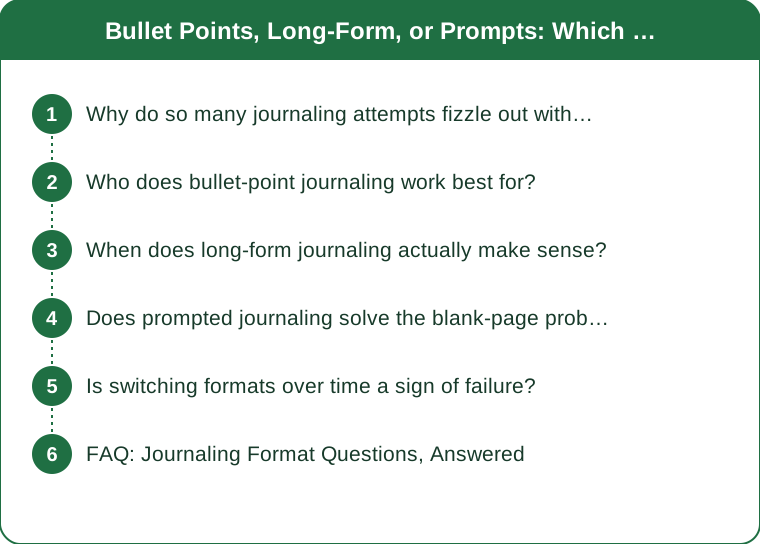
Why do so many journaling attempts fizzle out within a few weeks?
A common pattern is starting with an ambitious long-form format because it looks appealing, then abandoning it once daily life gets busy and a full page feels like too much of an ask — the format, not lack of commitment, is often the actual point of failure.
Who does bullet-point journaling work best for?
People who want a quick, low-friction daily record — mood, a few events, a couple of gratitude notes — tend to sustain bullet-style journaling longer because each entry takes under two minutes, removing the main barrier to daily consistency.
When does long-form journaling actually make sense?
Long-form writing suits processing complex emotions or working through a specific problem, where the act of writing at length genuinely helps organize thinking — it’s less suited as a daily maintenance habit and more useful used situationally, when there’s actually something substantial to work through.

Does prompted journaling solve the blank-page problem effectively?
For people who find an open blank page intimidating or don’t know what to write about, a specific prompt removes that initial decision barrier, often making the difference between actually writing and closing the notebook unused.
Is switching formats over time a sign of failure?
No — many consistent long-term journalers naturally shift formats depending on what’s happening in their life, using quick bullet entries during busy stretches and longer entries during periods that call for more processing. Flexibility in format tends to support consistency better than rigid adherence to one style.
FAQ: Journaling Format Questions, Answered
Is it better to journal every day, or only when there’s something to say?
Either approach can work, but committing to a specific frequency in advance — daily bullets versus as-needed long-form — tends to produce more consistency than an open-ended ‘whenever I feel like it’ approach.
Does the format matter more than the physical journal itself?
Yes — a beautiful notebook doesn’t fix a format mismatch, while a plain notebook with the right format for your actual habits and goals tends to get used far more consistently.
Can I combine multiple formats in the same journal?
Absolutely — many people use quick bullet entries most days with an occasional longer reflective entry when something specific warrants it, getting the consistency benefit of one format and the depth benefit of the other.
TL;DR:
- Format mismatch, not lack of discipline, is the usual reason journaling habits fizzle
- Bullet-style entries suit quick daily consistency
- Long-form writing works best used situationally for complex processing
- Prompts remove the blank-page barrier for many people
- Switching formats over time is normal, not a sign of failure
Finding the format that matches your actual reason for journaling predicts a lasting habit far better than picking whatever style looks most appealing in a store display.
Keep Reading
This article is for general informational and styling purposes only. Fit, sizing, and product availability may vary.