Journaling for Beginners: Three Lines a Night Can Rewire Your Head
Journaling has an intimidating brand: leather notebooks, dawn rituals, people who write things like the fog taught me something today. Ignore all of it. The evidence-backed core of journaling is almost embarrassingly small — a few honest lines, most days — and the returns are outsized: clearer thinking, processed emotions, documented growth, better sleep for the mind. Three lines a night is a complete practice. Here is the realist’s guide.

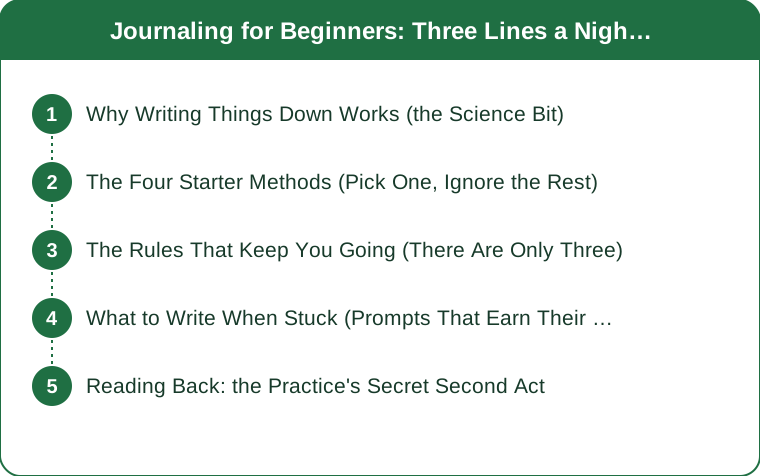
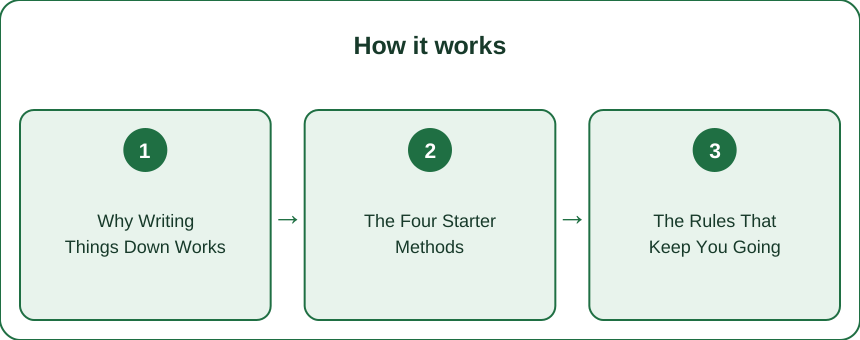
Why Writing Things Down Works (the Science Bit)
Your brain treats unwritten worries like open browser tabs — cycling, refreshing, draining the battery. Writing closes tabs: expressive-writing research (decades deep, starting with Pennebaker’s famous studies) shows that putting stressful experiences into words measurably lowers rumination and improves mood, and affect-labeling brain imaging suggests naming a feeling literally quiets the amygdala’s alarm. Gratitude-writing studies add sleep and optimism improvements to the pile. None of it requires literary talent. The mechanism is externalization: on paper, thoughts hold still long enough to be seen — and seen thoughts shrink.
The Four Starter Methods (Pick One, Ignore the Rest)
Method one — Three Lines: tonight’s best moment, today’s heaviest thing, tomorrow’s one priority; ninety seconds, shockingly complete. Two — the Gratitude Trio: three specific things (specific is the active ingredient: the 4pm breeze on the walk, not just family). Three — the Brain Dump: five unedited minutes of everything circulating, no structure, then close the notebook like a lid on a pot. Four — One Line a Day: a single sentence in a five-year format, which becomes a time machine by year two. All four work. The best one is whichever you will actually repeat.

The Rules That Keep You Going (There Are Only Three)
One: lower the bar until stepping over it is trivial — one line counts, bad handwriting counts, bullet fragments count; perfectionism is the practice’s only real predator. Two: anchor it to an existing habit — journal lives on the pillow or beside the coffee maker, writing happens after the existing ritual, no decision required. Three: privacy is a feature — write as if no one will ever read it, because honesty is where the benefit lives; a journal performing for an imaginary audience is just slow social media. Miss a day, miss five — the streak was never the point. Returning is.
What to Write When Stuck (Prompts That Earn Their Ink)
For blank-page nights, the reliable openers: What is taking up the most space in my head right now? What would I tell a friend in my exact situation? What drained me today, and what refilled me? What am I avoiding, and what is the smallest first step? What went better than expected this week? And the underrated closer: What do I want tomorrow-me to remember? Prompts are training wheels, not curriculum — most people need them for two weeks, then the pen finds its own way to whatever actually needs saying. It always knows.
Reading Back: the Practice’s Secret Second Act
The compounding return arrives later: once a month, skim backward. You will find worries that consumed whole weeks and then simply dissolved (recalibrating how seriously to take this week’s version), patterns your daily self cannot see — the same energy drains, the same recurring wish, the Sunday dread with suspiciously perfect attendance — and hard evidence of growth that memory, an unreliable narrator, had already smoothed over. The daily writing processes life; the monthly reading reveals it. Together they turn three lines a night into the cheapest, most private form of therapy-adjacent maintenance available.
Journaling, deflated to its useful core: three honest lines, anchored to bedtime, private by design, reread monthly. No fountain pen, no fog metaphors, no dawn. The tabs in your head want closing and the patterns in your weeks want noticing — ninety seconds a night handles both. Put any notebook on your pillow this morning. Tonight, write the three lines. That is the entire initiation, and it is enough.
Keep Reading
This article is for general informational and styling purposes only. Fit, sizing, and product availability may vary.