Journaling for Stress Relief: Get It Out of Your Head and Onto the Page
When stress is swirling in your head, writing it down is one of the simplest, most effective ways to ease it. Journaling gets the worry out of your mind and onto the page, where it feels more manageable. Here is why journaling relieves stress, the techniques that work, and how to make it a habit.

Why Journaling Eases Stress
The page as an outlet: the the-gets-it-out-of-your-head (the writing worries down externalizing them so they stop swirling from the worry-dump logic — the empty-the-mind), the the-makes-it-manageable (the seeing thoughts on paper making them feel clearer and smaller — the clarity-shrinks-it), the the-processes-emotions (the writing helping you process feelings from the anxiety logic — the process-the-feelings), the the-calms-the-nervous-system (the the reflective act calming a stressed mind — the the-calm-effect), the the-perspective (the journaling creating distance and perspective on stressors — the the-zoom-out), the the-no-audience-no-judgment (the a private page letting you be fully honest from the beginners logic — the judgment-free), and the reframe (the journaling as an outlet that gets stress out of your head and onto the page — where it feels clearer and more manageable).

The Techniques That Help
Ways to journal for stress: the the-brain-dump (the writing out everything on your mind without editing from the worry-dump logic — the the-brain-dump), the the-scheduled-worry-time (the a set worry-dump time to contain anxious thoughts from the worry-dump logic — the the-worry-window), the the-morning-pages (the free-writing pages to clear the mind from the morning-pages logic — the the-clearing-pages), the the-gratitude-journaling (the noting what you are grateful for to shift focus from the gratitude logic — the the-gratitude-shift), the the-prompts-for-reflection (the prompts to explore and process feelings from the prompts logic — the the-guided-reflection), the the-name-the-feelings (the naming emotions to defuse them from the anxiety logic — the name-to-tame), the the-problem-solving-on-paper (the writing through a stressor to find next steps — the think-on-paper), and the the-just-write-freely (the writing however feels right, no rules from the beginners logic — the no-wrong-way).
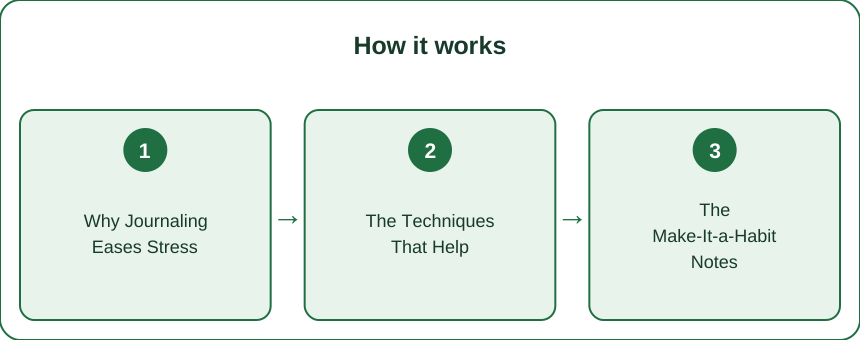
The Make-It-a-Habit Notes
Building the habit: the the-keep-it-low-pressure (the no rules, no perfect entries, just writing from the beginners logic — the no-pressure), the the-anchor-it (the attaching journaling to a daily cue — morning or bedtime from the morning-pages logic — the the-cue), the the-start-small (the a few minutes or lines to begin from the beginners logic — the tiny-and-doable), the the-keep-it-accessible (the a notebook or app within easy reach — the remove-friction), the the-use-it-when-stressed (the reaching for the page when stress hits, not only on schedule — the the-in-the-moment-tool), the the-consistency-over-length (the short regular entries over occasional long ones — the little-and-often), the the-private-and-honest (the keeping it private so you write freely from the beginners logic — the honest-writing), and the frame (the journaling for stress as a low-pressure brain-dump, worry-time or gratitude practice anchored as a small habit — getting stress out of your head and onto the page. Do a brain-dump, try scheduled worry time or gratitude, keep it low-pressure and private, and anchor it to a daily cue).
When stress is swirling in your head, writing it down is one of the simplest, most effective ways to ease it — journaling gets the worry out of your mind and onto the page, where it feels more manageable. It eases stress by externalizing worries so they stop swirling, making thoughts clearer and smaller, helping you process emotions, calming the nervous system, creating perspective, and offering a judgment-free outlet. The techniques that help: a brain-dump, scheduled worry time, morning pages, gratitude journaling, reflective prompts, naming feelings, and problem-solving on paper — writing freely with no rules. Make it a habit by keeping it low-pressure, anchoring it to a daily cue, starting small, keeping it accessible, using it in stressful moments, staying consistent, and keeping it private. Get stress out of your head and onto the page.
Keep Reading
This article is for general informational and styling purposes only. Fit, sizing, and product availability may vary.