What to Do When Journaling Makes You Feel Worse Instead of Better
Quick Answer: Journaling backfires when it becomes rumination — circling a problem without moving through it. The research-backed fix is structural: write about the event and what it means rather than only how it feels, use past tense and third person for hard material, set a timer, and always end with a forward-looking line. If writing consistently leaves you worse for hours, stop and talk to someone instead. Not everyone benefits from expressive writing, and that’s a documented finding, not a personal failing.
You were told journaling helps. You’ve been doing it for a month and you feel measurably worse. That’s a real phenomenon with real explanations.

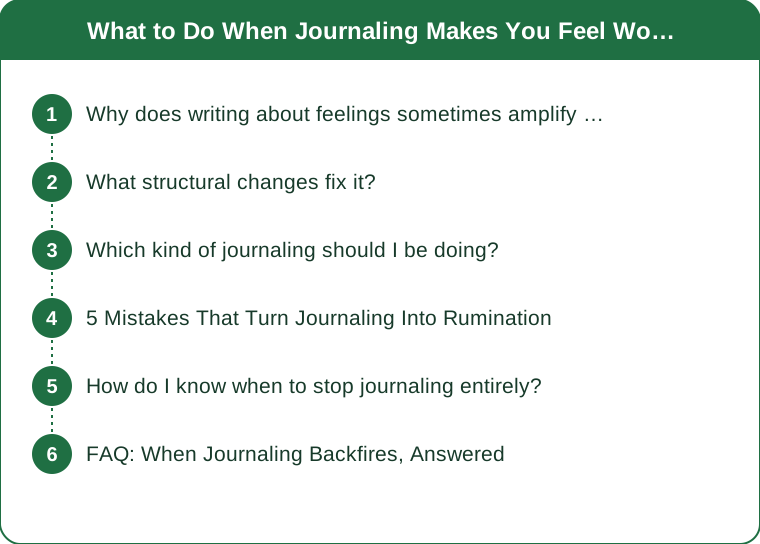
Why does writing about feelings sometimes amplify them?
Because there’s a thin line between processing and rehearsing, and journaling can land on either side.
Processing means moving through an experience toward some understanding. Rehearsing means going over it repeatedly in the same groove. On the page they can look nearly identical, and only one helps.
The clearest marker is whether the writing goes anywhere. If you re-read last month’s entries and they’re the same complaint in the same words, you’ve been rehearsing. Rumination has a strong association with depressive symptoms, and writing can be an unusually efficient vehicle for it.
Pure emotional venting without meaning-making is the specific pattern that tends not to help. Expressive writing research has generally found benefits when writing includes causal and insight language — words like because, realize, understand — rather than emotion words alone.
Repetition also strengthens the memory trace. Writing the same painful narrative repeatedly can reinforce it — which is roughly the opposite of what you were after.
What structural changes fix it?
Four, and they’re small enough to apply tonight.
Set a timer for 15 to 20 minutes and stop when it goes. Classic expressive writing protocols use bounded sessions for a reason. Open-ended writing is where circling happens. The boundary is the intervention.
Write about what happened and what it means, not only how it felt. Prompt yourself with “why did this affect me the way it did” and “what does this tell me.” Feeling-only entries are the ones that most reliably slide into rumination.
Use past tense and third person for difficult material. Writing “she felt overwhelmed when” instead of “I feel overwhelmed” creates distance, and self-distanced reflection has been shown to reduce emotional reactivity compared to immersed first-person recounting.
End every entry with one forward-looking sentence. One thing you’ll do, one thing that helped, one thing that’s true tomorrow. This single rule changes the emotional exit point of the session, and the exit point is what you carry with you.
Which kind of journaling should I be doing?
Match the format to the state you’re in — the mismatch is what causes most of the harm.
When actively distressed: structured, bounded, distanced. Timer on, past tense, one page maximum, forward-looking close. This is not the time for open-ended exploration.
When processing something resolved: expressive writing works well. The classic protocol — 15 to 20 minutes for three or four consecutive days about a significant experience — has the strongest evidence base, and it works best on material that has some distance already.
When stuck in a loop: switch to problem-solving format entirely. What’s the situation, what’s within my control, what’s one action, when will I do it. This isn’t journaling in the emotional sense and that’s exactly why it helps.
When generally low: gratitude or neutral logging. Three specific good things, or a plain factual record of the day. Low-emotional-content writing still provides structure and reflection without opening anything.
When you don’t know: log facts only for a week. What you did, what you ate, when you slept. It sounds pointless and it’s often the thing that breaks the loop.

5 Mistakes That Turn Journaling Into Rumination
1. Writing without a time limit. Open-ended sessions drift into circling. The 15-minute timer isn’t a productivity trick — it’s a boundary on how long you sit inside something difficult.
2. Writing at night, right before sleep. You open something emotionally activating and then immediately try to sleep. Move it to morning or early evening — the difference in how the rest of your night goes is substantial.
3. Only writing when you feel terrible. If journaling exists solely as a distress response, your brain builds an association between the notebook and feeling awful. Write on ordinary days too, even briefly.
4. Re-reading old painful entries. Going back through difficult material without a specific purpose is re-exposure. Re-read for patterns and progress, not to revisit. And not on a bad day.
5. Writing the same entry repeatedly with no new angle. The clearest signal you’ve moved from processing to rehearsing. If three entries in a row are the same complaint, change format — go to problem-solving or stop.
How do I know when to stop journaling entirely?
When the evidence is consistent and you’ve already tried the structural fixes.
The signal: you feel reliably worse for hours afterward, not for minutes. Some short-term discomfort after writing about hard things is normal and expected. A persistent drop that carries into the next day is different.
Give the structural changes two weeks first — timer, distancing, meaning-focus, forward-looking close. A lot of what looks like “journaling doesn’t work for me” is actually “unstructured journaling doesn’t work for me,” which is a much smaller problem.
If it’s still net negative after that, stop. Expressive writing benefits vary considerably across people and some studies find no benefit or worse outcomes for certain individuals. It’s a tool, not a moral obligation.
Alternatives that serve similar functions: talking with someone, voice memos you delete afterward, physical activity, structured problem-solving without the emotional narrative.
If you’re consistently distressed, if difficult material feels unmanageable, or if writing surfaces things you can’t put down — that’s a signal to talk to a mental health professional rather than to write harder. This is general information, not a substitute for mental health care.
FAQ: When Journaling Backfires, Answered
Is it normal to feel worse immediately after writing?
Short-term, yes — expressive writing research often finds a temporary mood dip right after sessions, with benefits appearing over following weeks. The distinction that matters is duration. Minutes to an hour is expected. All evening and into the next day is a different signal.
Should I write about trauma in a journal?
Cautiously, and generally not alone as a first approach. Trauma-focused writing has been studied, but it’s typically done within a structured protocol and often with professional support. Writing about significant trauma alone, unbounded, at night, is the specific combination most likely to go badly.
Does typing versus handwriting change anything?
Some people find handwriting slower and more reflective, and typing faster and easier to spiral in. If you tend toward rumination, handwriting’s slower pace and the physical page limit can act as natural brakes.
What if I only ever write when something’s wrong?
Common and worth changing. Add a two-line neutral entry on ordinary days — what you did, one thing that was fine. It breaks the association between the notebook and distress, and it gives you a baseline to compare against later.
TL;DR: Journaling that circles isn’t processing — it’s rumination with better handwriting.
- Set a 15 to 20 minute timer. Unbounded sessions are where circling lives.
- Write about meaning, not only feeling. Prompt with “why did this affect me” and “what does this tell me.”
- Use past tense and third person for hard material — self-distancing measurably lowers reactivity.
- End every entry with one forward-looking sentence. The exit point is what you carry.
- Move it out of bedtime, and write on ordinary days too, not only bad ones.
- If you still feel worse for hours after two weeks of this, stop and talk to someone instead.
Not everyone benefits from expressive writing. That’s a finding in the literature, not a failure on your part.
Keep Reading
This article is for general informational and styling purposes only. Fit, sizing, and product availability may vary.