What to Do When Your Journal Becomes a To-Do List
Quick Answer: Journals drift into task lists because planning is easier than reflecting — it’s concrete, it produces a visible result, and it lets you avoid whatever you’d otherwise have to sit with. The fix isn’t discipline. Separate the two physically: a capture page for tasks, and a different page or notebook for reflection. Once the tasks have somewhere to go, the reflective writing comes back on its own.
You open the notebook to think about your week. Twenty minutes later you have a list of errands and a plan for Thursday.
That’s not a failure of focus. It’s what happens when one page is asked to do two incompatible jobs.

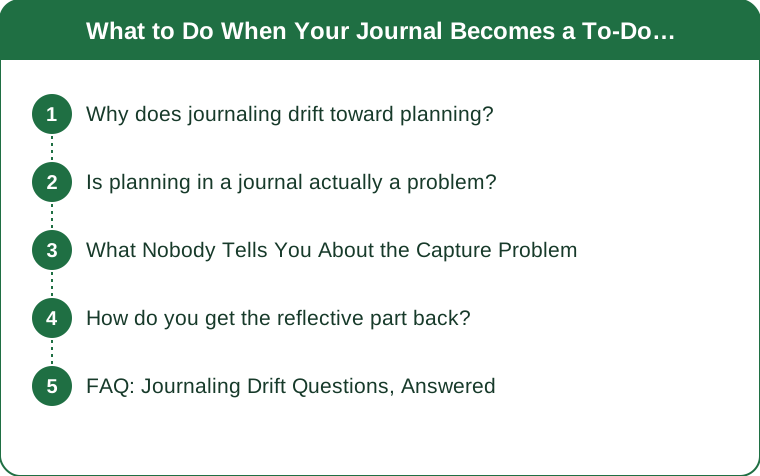
Why does journaling drift toward planning?
Three reasons, and the third is the one that matters.
Planning is cognitively easier. Listing tasks is retrieval — pulling out things you already know. Reflection requires generating something that doesn’t exist yet: an interpretation, a connection, an honest read on how you feel. When you’re tired, and journaling usually happens when you’re tired, the brain reliably takes the easier path.
Planning produces visible output. A list of nine tasks looks like you accomplished something. Three paragraphs about being unsettled and not knowing why looks like nothing, even when it did far more.
Planning is avoidance with excellent cover. This is the real mechanism. If there’s something you’d rather not think about — a decision you’re postponing, a relationship that’s off, a feeling you haven’t named — the mind will find something productive to do instead. Task-listing is the perfect candidate because it’s genuinely useful, so it never feels like avoidance.
The tell for this last one: the drift is worse in the weeks you most need to reflect. If your journal fills with logistics precisely when life is complicated, that’s not a coincidence.
Is planning in a journal actually a problem?
Not inherently — and it’s worth being clear about this before you fix something that isn’t broken.
Plenty of people keep a hybrid journal on purpose, and it works. Bullet journals are built on exactly this premise. If you’re writing tasks and it’s serving you, there’s nothing to fix.
It becomes a problem when:
- You sit down to reflect and consistently don’t
- You feel vaguely dissatisfied after journaling, without knowing why
- Rereading old entries tells you what you did and nothing about who you were
- The same unresolved thing keeps not getting written about
That last one is the strongest signal. A journal that’s genuinely working occasionally makes you uncomfortable — it surfaces things you’d rather leave alone. One that only ever produces tidy lists has stopped doing that, and the drift may be exactly the point.
The reframe: you don’t have a discipline problem. You have two different needs — capture and reflection — competing for one page, and capture wins every time because it’s louder and easier.

What Nobody Tells You About the Capture Problem
Here’s what’s actually happening, and it’s more mechanical than it feels.
When you sit down to write, your mind is holding a set of unfinished tasks. Unfinished tasks are noisy — they keep surfacing because nothing has been done to resolve them. Research on this is well known: the mind tends to keep incomplete intentions active until they’re either completed or specifically planned.
That second part is the key. You don’t have to do the task to quiet it. You have to write it down with enough specificity that it’s handled. Once it has a place, the noise stops.
Which means the drift toward task-listing isn’t laziness. It’s your mind clearing the queue so it can think — and it’s doing exactly the right thing. The problem is that it’s using the reflection space to do it, and once the momentum of listing starts, it doesn’t stop on its own.
The implication for the fix: don’t try to suppress the capture. Give it two minutes and a different page, deliberately, before you write anything else. You’re not fighting the impulse; you’re satisfying it early so it stops interrupting.
People who try to power through — refusing to write the tasks, forcing themselves to reflect — usually find the tasks keep resurfacing mid-sentence. The queue doesn’t clear itself just because you’ve decided to ignore it.
How do you get the reflective part back?
Five things, roughly in order of how well they work.
1. Do a two-minute brain dump first, on a separate page. Set a timer, write every task and open loop that surfaces, don’t organize it. Then close that page and start the real entry. This alone resolves it for most people.
2. Use physically separate spaces. Different notebook, or at minimum the back of the same one for tasks and the front for reflection. Physical separation does more than intention does — same page means the same drift, every time.
3. Start with a question, not a blank page. A blank page is an invitation to write whatever’s easiest. A question forces the harder mode. Useful ones: What did I avoid thinking about today? / What surprised me this week? / What would I tell a friend in my situation? / What am I pretending not to notice?
4. Write about something already finished. Tasks are future-oriented, so writing about the past sidesteps the pull entirely. Describe something that happened today in detail rather than assessing where things stand.
5. Change the time of day. Evening journaling sits right next to tomorrow’s planning, so the drift is nearly built in. Morning or midday entries — even brief ones — are far less prone to it because the day’s logistics aren’t immediately at hand.
If none of it works and the tasks keep winning: that’s worth noticing rather than fixing. Persistent avoidance of reflection usually means there’s a specific thing being avoided. Sometimes the useful entry is simply: I keep writing lists instead of writing about this. Here’s what this is.
FAQ: Journaling Drift Questions, Answered
Should I keep two separate notebooks?
If you’ll actually carry both, yes — it’s the cleanest solution. If not, use one notebook from opposite ends, or a dedicated capture page at the front. Digital capture with paper reflection also works well and keeps the tasks somewhere searchable.
Why does this happen more in busy periods?
Two reasons stacking: more open tasks means a noisier queue, and busy periods usually carry more you’d rather not examine. Busy weeks are when the two-minute brain dump earns the most.
Is it bad that my entries got shorter over time?
Not necessarily — practiced journalers often write more concisely because they get to the point faster. It’s worth attention only if shorter also means more superficial. The test isn’t length; it’s whether the entry told you something you didn’t already know when you sat down.
TL;DR:
- Journals drift toward task lists because planning is easier, produces visible output, and provides excellent cover for avoidance.
- Unfinished tasks stay noisy until written down specifically — the capture impulse is your mind clearing the queue, not laziness.
- Give it two minutes on a separate page before you start the real entry.
- Separate the spaces physically, start with a question instead of a blank page, and try writing at a different time of day.
- If the drift persists despite all of it, that’s information about what you’re avoiding.
Try the two-minute dump before your next entry. Most people find the reflective writing returns immediately, which tells you it was never the discipline that was missing.
Keep Reading
This article is for general informational and styling purposes only. Fit, sizing, and product availability may vary.