Why Journaling About the Same Problem Eventually Stops Helping
Quick Answer: Writing about a difficult experience helps when it involves making meaning - explaining, connecting, and moving toward a new understanding. It stops helping when entries become repetitive descriptions of the same feelings, which resembles rumination rather than processing. The signals are entries that could be swapped between weeks without noticing, feeling worse after writing rather than clearer, and no shift in the language you use about the problem.
You have written about the same situation twenty times. The first few entries helped enormously. The last several have left you feeling worse, and you have started avoiding the notebook.

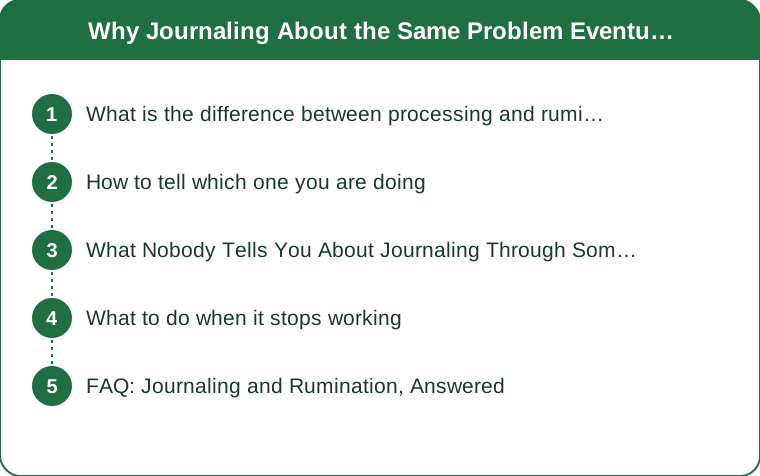
What is the difference between processing and rumination?
The distinction that determines whether writing helps or harms.
Expressive writing research generally finds benefits for wellbeing when people write about difficult experiences - but the studies that show benefit typically involve a limited number of sessions, and the mechanism appears to involve constructing an explanation rather than simply venting.
Meaning-making is what appears to help. Entries that explain, connect events, consider other perspectives, and reach conclusions tend to be associated with benefit. Entries that only describe feelings, repeatedly, tend not to be.
Rumination is repetitive, passive focus on distress and its causes without moving toward resolution. It is associated with worse outcomes, and writing can be a vehicle for it as easily as thinking can.
Written rumination can feel more productive than it is. The act of writing gives a sense of doing something about a problem, which can sustain a cycle that is not actually going anywhere.
Language change is the marker researchers look at. Increased use of causal and insight words - because, realise, understand - across entries is associated with benefit. Entries whose vocabulary does not shift over weeks are a signal worth noticing in your own writing.
How to tell which one you are doing
Concrete signals, from your own notebook.
The interchangeability test. Read an entry from a month ago and one from this week. If you could swap them without noticing, you are describing rather than processing.
How you feel afterwards. Writing that processes typically leaves you feeling clearer, lighter, or at least more settled, even when the subject is painful. Writing that ruminates leaves you feeling worse or agitated. A short lift of distress during writing is normal; a consistent worsening afterwards is the signal.
Whether the language has changed. Look for whether you are asking different questions than you were a month ago, or using words that indicate understanding rather than only feeling.
Whether there are any conclusions. Entries that end mid-feeling, week after week, without any attempt at explanation or next step, are more likely to be rehearsing than processing.
Whether you dread it. Avoiding the notebook is meaningful information. People generally do not avoid something that reliably makes them feel better.
A caveat worth stating: early entries about something painful are often just description, and that is a normal starting point. The signal is the absence of change over weeks, not the presence of description in any one entry.

What Nobody Tells You About Journaling Through Something Hard
A structured prompt frequently works better than free writing for a stuck topic. Free writing about a problem you have circled for months tends to reproduce the circle. A prompt forces a different angle.
Writing to a time limit helps. Twenty minutes, then stop, whether or not you feel finished. Open-ended writing about distress is where sessions run long and turn into rumination.
Changing person changes perspective. Writing about the situation in the third person - using your own name, or “she” - produces measurable psychological distance and often unlocks something that first-person writing has not.
A deliberate break is a legitimate intervention. Two weeks of not writing about a topic is not avoidance; it interrupts the rehearsal loop, and topics frequently look different afterwards.
Not everyone benefits from expressive writing, and that is a documented finding rather than a personal failing. For some people, and for some topics, writing about distress increases rather than reduces it.
And the important one: journaling is not a substitute for therapy when a problem is persistent and significantly affecting your life. Writing about something for eight months without change is information about the problem, not about your writing practice.
This is general information, not medical or psychological advice. Persistent low mood, anxiety, or distress warrants speaking with a healthcare professional.
What to do when it stops working
Options, roughly in order of how much they change.
Switch to a structured prompt. “What would I tell a friend in this situation?” “What has changed about this in the last month?” “What am I avoiding writing?” “What would need to be true for this to be resolved?” Specific questions produce different answers than open pages.
Write toward action rather than feeling. One concrete step, however small, at the end of an entry. This shifts the practice from describing a state to changing one.
Set a limit on the topic. Ten minutes on the difficult thing, then ten on something else. Confining it prevents it absorbing every session.
Write the other side. Deliberately write the strongest version of a perspective you disagree with, or the version of events in which you were not wronged. Uncomfortable, and frequently the most productive thing available.
Take the two-week break from the topic specifically, while continuing to journal about other things. The break is often what allows the shift.
Talk to someone instead. Some material processes better in conversation than on paper, particularly anything involving another person’s perspective, which is very hard to generate alone.
And consider whether the writing is the problem. If a situation has not changed in months and writing has not helped, the answer may lie in changing the situation rather than in finding a better way to write about it.
FAQ: Journaling and Rumination, Answered
Why does journaling about my problem make me feel worse?
Most likely because the entries have shifted from processing to rumination - repeatedly describing the same distress without moving toward explanation or resolution. A brief increase in distress during writing is normal; consistently feeling worse afterwards is a signal to change approach.
How do I know if I am ruminating in my journal?
Read an entry from a month ago alongside a recent one. If they are interchangeable, and if the language you use has not changed, you are rehearsing rather than processing. Dreading the notebook is another reliable signal.
Should I stop journaling about it entirely?
A deliberate two-week break from that topic, while continuing to write about other things, often helps more than pushing through. It interrupts the loop, and the topic frequently looks different afterwards.
Does expressive writing actually work?
Research generally supports benefits from a limited number of writing sessions about difficult experiences, with the benefit apparently tied to constructing meaning rather than venting. It does not work for everyone, and that is a documented finding rather than a personal failing.
When should I talk to someone instead of writing?
When a problem persists across months without change, when writing consistently makes you feel worse, or when the difficulty is affecting sleep, work, or relationships. Journaling is a useful tool and not a substitute for professional support.
TL;DR:
- Writing helps when it makes meaning; it stops helping when it repeats description without moving anywhere.
- The test: if an entry from a month ago is interchangeable with this week’s, you are rehearsing, not processing.
- Feeling worse afterwards, and avoiding the notebook, are both meaningful signals.
- Structured prompts, third-person writing, time limits, and a deliberate two-week break all interrupt the loop.
- Months of writing without change is information about the problem, not about your practice - consider talking to someone.
The first five entries did real work. The next fifteen have been the same entry, and the notebook has stopped being where you think and started being where you repeat.
Keep Reading
This article is for general informational and styling purposes only. Fit, sizing, and product availability may vary.