Why Journaling Feels Impossible Some Nights and Easy Others
Quick Answer: Journaling difficulty usually tracks mental load, not motivation — on high-cognitive-load days, your brain has less capacity left for the reflective processing journaling requires, which is why the same habit that felt effortless Tuesday can feel impossible Thursday with zero change in your commitment to it.
You didn’t lose your journaling habit. Some nights genuinely require more from your brain to translate the day into words than others do, and that’s a real cognitive difference, not a discipline failure.

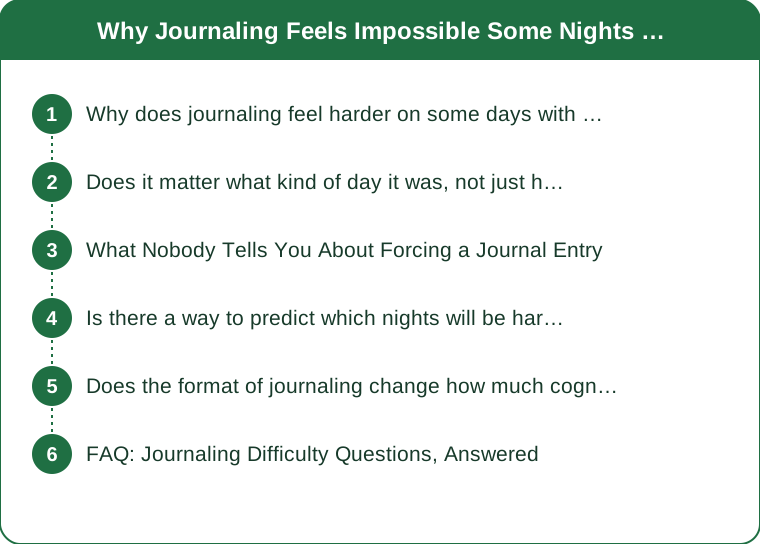
Why does journaling feel harder on some days with no obvious reason?
Because writing reflectively is a genuinely demanding cognitive task — it requires converting the day’s events and feelings into language, which draws on the same mental resources that get depleted by decision-making, emotional regulation, and problem-solving throughout the day. On days with unusually high cognitive load (a hard meeting, an emotionally taxing conversation, simple decision fatigue from a busy schedule), there’s measurably less capacity left for the reflective translation journaling asks for — even if the day wasn’t dramatic on the surface.
Does it matter what kind of day it was, not just how busy?
Yes — emotionally complicated days (mixed feelings, unresolved conflict, ambiguous outcomes) tend to be harder to journal about than clearly good or clearly bad days, because clear emotions translate to language more easily than ambivalent ones. A straightforwardly great day or a straightforwardly rough day often journals faster than a day that was ‘fine, I guess, but something felt off’ — the ambiguity itself takes more cognitive work to articulate.
What Nobody Tells You About Forcing a Journal Entry
Pushing through a genuinely blank-page night by forcing structured, detailed writing often produces the worst entries and the most resistance to trying again tomorrow. On low-capacity nights, permission to write something minimal — three bullet points, a single sentence, even just ‘tired, hard day, nothing to add’ — preserves the habit’s continuity without demanding cognitive resources you don’t currently have. The habit surviving matters more than any single entry’s depth.

Is there a way to predict which nights will be harder?
Roughly, yes — days with more decisions made, more social/emotional navigation, or less sleep the night before tend to correlate with harder journaling sessions. This isn’t a precise formula, but noticing the pattern over a few weeks (was today decision-heavy? emotionally complex? did I sleep poorly?) helps reframe a hard journaling night as an expected consequence of a demanding day, rather than a personal failing showing up randomly.
Does the format of journaling change how much cognitive load it demands?
Significantly. Open-ended free writing (‘write about your day’) demands more cognitive translation work than prompted or structured formats (three good things, a single gratitude line, a simple mood rating with one sentence). Keeping a low-effort backup format for depleted nights — switching from free writing to a simple prompt — lets the habit continue without requiring the same cognitive resources every single night.
FAQ: Journaling Difficulty Questions, Answered
Why do I sometimes stare at the page and write nothing?
Usually depleted cognitive capacity from a demanding day, not lack of things to say — the translation work journaling requires competes with the same mental resources used up by decisions and emotional processing earlier in the day.
Should I skip journaling on hard nights?
A minimal entry (even one sentence) generally preserves the habit better than skipping entirely, and doesn’t require the full cognitive effort a detailed entry does.
How can I make journaling easier on low-energy nights?
Keep a simple backup format (a single prompt, a mood rating, three bullet points) ready for nights when open-ended free writing feels like too much.
TL;DR:
- Journaling difficulty tracks cognitive load, not commitment — demanding days leave less capacity for reflection
- Emotionally ambiguous days are harder to write about than clearly good or bad ones
- A minimal entry on hard nights preserves the habit better than forcing depth or skipping entirely
- Keep a simple backup format ready for depleted nights instead of only offering free writing
A hard journaling night isn’t the habit breaking down — it’s your brain honestly telling you it had less to give today.
Keep Reading
This article is for general informational and styling purposes only. Fit, sizing, and product availability may vary.