Why the First Line Is the Hardest Part of Journaling, and How to Skip It
Quick Answer: The first sentence is hard because it silently demands a decision about what the entry is about, what tone it takes, and who it is for - three choices at once, before you have written anything to base them on. Skip it entirely. Start mid-thought, use a fixed opening line every time, or begin with a physical detail. Once line one exists, lines two through twenty rarely cause problems.
You opened the notebook. You have been looking at it for four minutes.
Nothing about lines two through twenty is difficult - the entire resistance lives in the first one, and that is a solvable structural problem rather than a motivation one.

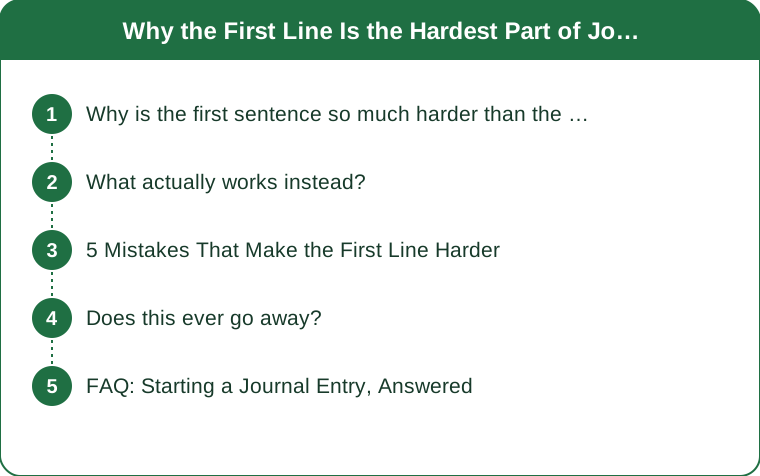
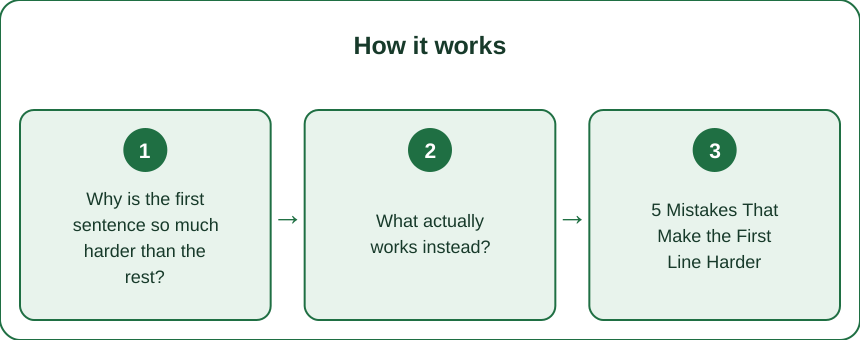
Why is the first sentence so much harder than the rest?
It carries three decisions at once. Choosing the subject, the tone, and the implied reader - and you have to make all three before you have written anything that could inform them.
Everything after it inherits those decisions, which is why line two takes four seconds and line one takes four minutes. The cost is front-loaded and it is not evenly distributed.
It also feels permanent in a way later lines do not. The opening sits at the top of the page and gets read first if you ever reread, so it quietly attracts a standard nothing else in the entry is held to.
And there is a summary trap. Many people feel the first line should encapsulate the day, which is genuinely hard - summarising is a different and more demanding task than describing.
Notice that talking has none of this problem. In conversation you start anywhere and the thing you actually meant emerges three sentences later. Writing feels like it needs the order reversed, and it does not.
Which means the solution is not to try harder at the first line. It is to stop requiring it to do any work.
What actually works instead?
Use a fixed opening line, every single time. Something deliberately unremarkable: Today was a … or Right now I am … or It is Tuesday and … The line is not meant to be good, it is meant to be automatic, and it removes all three decisions at once.
Start with a physical detail rather than a thought. What you can see, hear, or feel in the room. This is concrete, requires no interpretation, and reliably leads somewhere within two or three sentences.
Begin mid-thought, as though continuing something. The thing about today is that … or What I keep coming back to … Starting in the middle bypasses the opening entirely.
Write the second sentence first, deliberately skipping a line for the opening. Half the time you never go back and fill it in, and the entry is completely fine without it.
Answer a question instead of facing a blank. A single fixed prompt you use daily works better than a rotating list, because choosing among prompts is itself a version of the original problem.
Set a two-minute timer and do not stop the pen. Nonsense counts. The goal is producing text, and text produces more text - the mechanism is momentum rather than inspiration.

5 Mistakes That Make the First Line Harder
1. Waiting until you know what you want to say. Journaling is how you find out what you want to say. Waiting for clarity before writing reverses the actual function.
2. Rereading the previous entry first. It sets a comparison standard and a tone before you have written a word, and it is one of the most reliable ways to stall.
3. Using a beautiful notebook you do not want to spoil. The nicer the book, the higher the bar the first line has to clear. A cheap notebook genuinely produces more writing.
4. Starting with the hardest thing. If the day contained something difficult, the first line feels like it must address it. It does not. Write about the weather for three lines and arrive there naturally.
5. Journaling at the moment of least capacity. Late at night, after a full day, is when the three-decision cost of a first line is highest. The same entry at a different hour often writes itself.
The third one surprises people most, because a lovely notebook feels like an investment in the habit and it frequently functions as a barrier to it.
Does this ever go away?
Partly, and not in the way people expect. The first line stops being hard when it stops being a decision, which happens through repetition of a format rather than through improving as a writer.
Skilled writers still use the same trick. Fixed openings, physical details, starting mid-thought - these are standard tools, not beginner workarounds, and the resistance is structural rather than a skill gap.
Expect it to return after a gap. A fortnight away from journaling brings the blank-page difficulty straight back, because the automatic opening has lost its groove. Reinstating the fixed line is usually enough.
It also returns when the stakes rise. Writing about something genuinely difficult reintroduces the tone and audience questions the fixed opening was designed to remove.
Some days simply cost more, and those are the days the fixed line earns its place - the entries written on autopilot are frequently the ones worth rereading later.
Consistency matters more than quality here. An entry that starts with the same four words every day for a year is a far better record than twenty beautifully opened entries scattered across the same period.
FAQ: Starting a Journal Entry, Answered
Why can I talk about my day easily but not write the first line?
Because conversation lets you start anywhere and arrive at the point later. Writing feels like it demands the subject, tone, and audience decided upfront - and it does not, which is what the fixed opening exploits.
Is it cheating to use the same opening line every day?
No, it is the actual solution. Repetition removes the three decisions that make the first line expensive, and the sameness becomes invisible within a week.
What if I have nothing to write about?
Start with a physical detail - what you can see or hear right now. It requires no interpretation and reliably leads somewhere within two or three sentences.
Should I journal at the same time each day?
It helps considerably, because it removes another decision. Avoid the time of day when you have least capacity, which for most people is late at night.
How long should an entry be?
Long enough to have started. Three sentences daily beats a page weekly for most purposes, and short entries are much less likely to be skipped.
Does typing make the first line easier?
Often yes, because the text feels less permanent and easier to revise. If handwriting is stalling you, typing is a reasonable swap rather than a compromise.
Why does the difficulty come back after a break?
The automatic opening loses its groove. Reinstating the fixed first line for a few days usually restores it faster than trying to write your way back in.
TL;DR:
- The first line is hard because it demands three decisions at once - subject, tone, and audience - before you have written anything to base them on.
- Nobody stalls at line four, which tells you the problem is structural, not motivational.
- Use a fixed, deliberately unremarkable opening every time, or start with a physical detail, or begin mid-thought.
- Rereading the previous entry and using a too-nice notebook both raise the bar before you start.
- Expect the difficulty to return after a break or when the subject is hard - reinstate the fixed line rather than pushing through.
Three sentences daily beats a page weekly. Consistency is the whole game here.
Keep Reading
This article is for general informational and styling purposes only. Fit, sizing, and product availability may vary.