Why Writing About a Good Day Is Harder Than Writing About a Bad One
Quick Answer: Bad days generate more writing because unresolved experiences stay mentally active and demand processing, while good days resolve on their own and leave nothing to work through. Writing works partly by making sense of difficulty, so it has less to do on a good day. Recording good days is still worth it — but it needs a different approach: specific detail rather than summary, and lower expectations of how it will feel.
A hard day gives you three pages before you look up.
A genuinely good day gives you: Nice day. Went to the market. Felt fine.
That asymmetry is not a failure of gratitude.

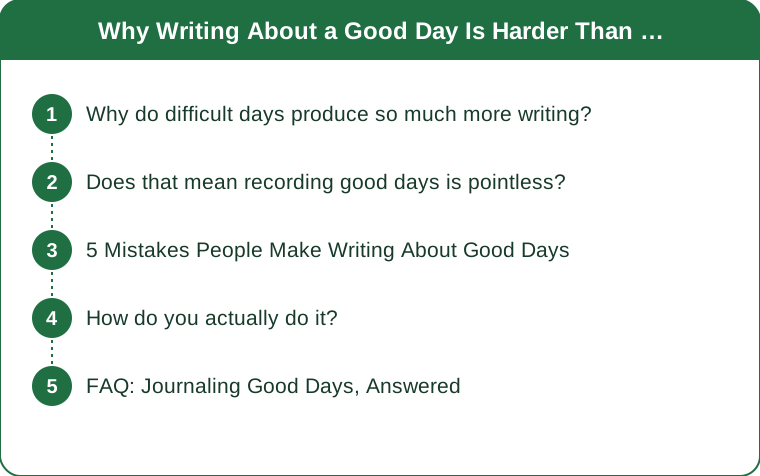
Why do difficult days produce so much more writing?
Because unfinished business occupies the mind and finished business does not.
Unresolved situations stay mentally active. There is a well-described tendency for incomplete or interrupted tasks to remain more accessible in memory than completed ones. A difficult conversation you have not made sense of stays available, keeps resurfacing, and produces material every time you sit down.
A good day is complete. Nothing needs resolving, so there is no loop pulling it back into your attention. It resolves and recedes, which is exactly what you want it to do emotionally and exactly what makes it hard to write about.
Expressive writing works by making meaning. The research on writing about difficult experiences suggests much of the benefit comes from constructing a coherent narrative — organising something confusing into something structured. Good days do not need that work, so the writing has no job to do.
Negative experiences generate more detail to work with. There is a general asymmetry in how strongly negative and positive events register, which means the bad day simply gives you more raw material even when the good day was objectively more significant.
Language is better equipped for it. We have far more precise vocabulary for distress than for contentment. Good is a blunt word doing a lot of work, and reaching for precision on a good day genuinely is harder.
Does that mean recording good days is pointless?
No — but it needs different expectations and a different method.
The purpose is different. Writing about a hard day is processing. Writing about a good day is record-keeping — you are storing something that would otherwise disappear, because pleasant days blur together in memory far more than difficult ones do.
Rereading is where the value lands. Entries about good days are usually the ones worth revisiting years later, and they are almost always the ones people wish they had written more of. The entry that feels pointless to write is frequently the one that matters most to read.
It counteracts a real memory bias. If your journal contains only difficult days, rereading it produces a distorted account of your life, because the good stretches left no record. A number of people report exactly this — going back through old journals and being surprised at how relentlessly bleak the picture is compared to how the period actually felt.
But do not expect it to feel meaningful in the moment. Writing about a good day usually feels flat, and interpreting that flatness as a sign you are doing it wrong is the reason most people stop. The value is deferred, not immediate.

5 Mistakes People Make Writing About Good Days
1. Summarising instead of describing. Had a lovely day is a category, not a memory, and it will jog nothing in five years. What makes a good-day entry worth rereading is specific concrete detail — what someone said, what the light was doing, what you ate, what made you laugh. One sentence of real detail beats a paragraph of summary.
2. Reaching for significance. Trying to extract a lesson or a meaning from a nice ordinary day makes the writing feel forced and slightly false. Most good days do not mean anything. Recording that they happened is the whole job.
3. Writing gratitude lists on autopilot. Listing the same three things nightly stops registering quickly — the research on gratitude interventions suggests specificity and variety matter, and that doing it less frequently sometimes works better than daily. A single specific thing that happened today beats a generic list.
4. Expecting the same emotional intensity. A good-day entry will not feel like the catharsis of writing through something difficult. That is the correct outcome, not a shortfall.
5. Skipping them because they feel unnecessary. The most common one. Nothing is wrong, so there is nothing to write, so the journal quietly becomes a record of only your hardest days. That is how a journal turns into something people dread rereading.
How do you actually do it?
Small, specific and quick.
Write one concrete detail, not a summary. The specific thing rather than the category. This is the single change that makes good-day entries worth keeping.
Use a shorter format for good days. A one-line entry is a legitimate entry. Some people keep a separate one-line-a-day book for exactly this, which removes the pressure of a blank page demanding depth.
Ask a different question. Rather than how was today, ask what is something I will have forgotten by next year. It reliably produces detail rather than assessment.
Write the mundane parts. The ordinary texture of a life — the route, the shop, the weather, the small routine — is what becomes interesting with time. The dramatic parts you remember anyway.
Do not force it into the same slot as difficult writing. Processing writing suits evenings; recording writing works fine at any point and is often easier in a spare two minutes during the day.
Accept an uneven journal. Some entries will be three pages and some will be one line, and that unevenness is an honest record rather than a problem to solve.
A seasonal note: as evenings darken and routines shift indoors through autumn, many people find journaling frequency increases while the content skews more reflective and more negative. Deliberately recording a few ordinary good days through this stretch keeps the record honest, and it is a genuinely useful thing to reread in February.
FAQ: Journaling Good Days, Answered
Is gratitude journaling actually effective?
Research generally supports modest wellbeing benefits, with specificity and variety mattering more than frequency. Some studies suggest a few times a week works better than daily, likely because daily repetition becomes automatic.
Should I write every day?
Only if it works for you. Many people find writing when there is something to record produces better entries than a daily obligation, which tends to generate filler.
Why do my entries get shorter over time?
Partly novelty fading, partly that you have already processed the recurring things. Changing the prompt or the format usually restarts it.
Will I actually reread this?
Most people do, eventually, and usually find the ordinary entries more interesting than the dramatic ones. That is a good reason to write the ordinary ones.
Is it bad that I only write when I am upset?
It is very common and not harmful, but it produces a lopsided record. A few one-line good-day entries a week is enough to balance it.
Does typing work as well as handwriting?
Both have benefits. Handwriting is slower, which some people find encourages reflection; typing is faster and lowers the barrier. The one you will actually do is the right one.
TL;DR:
- Bad days produce more writing because unresolved experiences stay mentally active and demand processing.
- Good days resolve on their own, so there is nothing for the writing to work through — that is the point, not a problem.
- Writing about good days is record-keeping, not processing. Expect it to feel flat and do it anyway.
- Write one concrete detail, not a summary. Specificity is what makes an entry worth rereading.
- A journal of only hard days produces a distorted account of your life when you go back through it.
The entries that feel pointless to write are usually the ones you will be glad to find later.
Keep Reading
This article is for general informational and styling purposes only. Fit, sizing, and product availability may vary.