Why Your Journal Voice Changes Depending on the Notebook
Quick Answer: Your journal voice changes with the notebook because expensive or beautiful notebooks raise your perceived stakes, and higher stakes trigger self-editing. Cheap, replaceable notebooks lower the cost of a bad page, so you write looser and more honestly. If you want raw entries, use a notebook you would not mind throwing away.
You bought the nice journal. Thick cream paper, ribbon marker, the whole thing. And then you opened it and wrote a sentence that sounded like a greeting card.
Meanwhile the water-stained notebook in your bag — the one with a grocery list on page three — gets the real stuff. The 11pm spiral. The thing you have not said out loud.
Same brain, same day, two completely different writers.

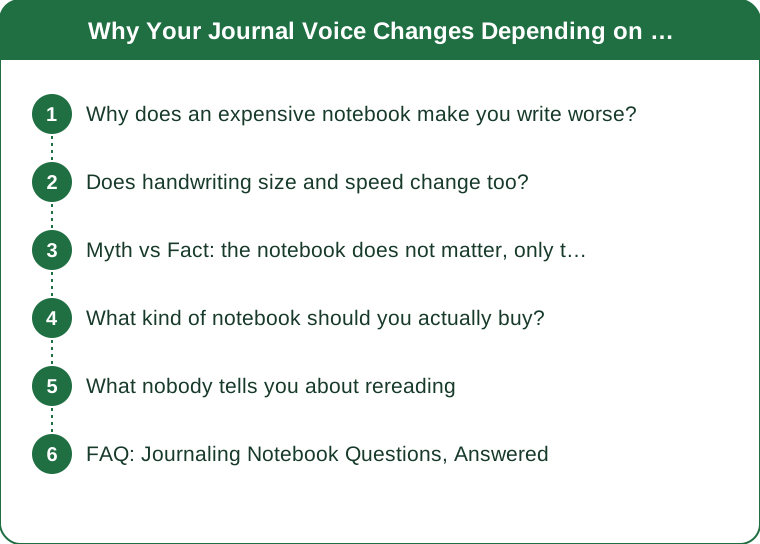
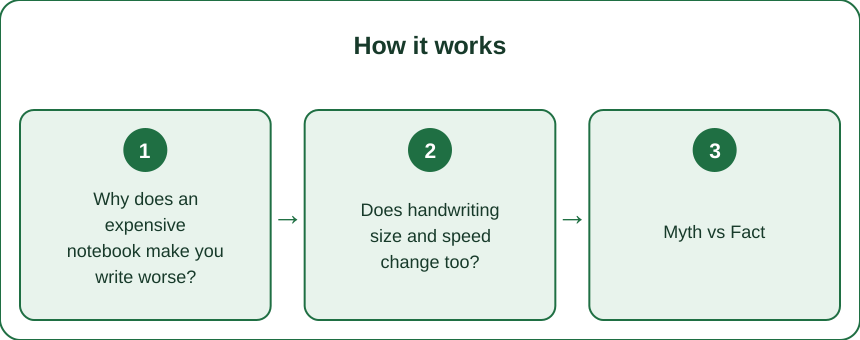
Why does an expensive notebook make you write worse?
Because a beautiful object creates an implied audience. Not a real one — nobody is reading it — but your brain runs the same calculation it runs before you post something publicly: is this good enough for the surface it is going on?
Researchers call this evaluation apprehension, and it does not care that the evaluator is imaginary. A $38 journal with hand-stitched binding whispers that the contents should match. So you reach for tidier sentences, you skip the ugly thought, and you write the version of your day that would survive being read.
A $4 composition book asks nothing. Ruin a page, tear it out, nobody grieves. That lower stake is exactly what lets the honest sentence through.
Does handwriting size and speed change too?
Yes, and this is the part people notice second. In a precious notebook, handwriting tends to get smaller, straighter, and slower — roughly 20 to 30 percent fewer words in the same ten minutes for most people who test it.
Slower writing is not neutral. When your hand moves slower than your thoughts, you have time to edit mid-sentence. That gap is where the interesting material gets quietly deleted.
Fast, sloppy writing outruns the editor. That is the whole mechanism behind morning pages and every timed free-write exercise ever assigned — speed is a censorship bypass.
Myth vs Fact: the notebook does not matter, only the habit does
Myth: A journal is a journal. If you are showing up, the container is irrelevant.
Fact: The container sets the permission level. It does not create the habit, but it absolutely shapes what the habit produces.
Myth: A nicer notebook will make you journal more often.
Fact: It usually makes you journal less often at first, because starting requires deciding the entry is worthy. People routinely go weeks without opening a gift journal, then fill a drugstore notebook in nine days.
Myth: You should pick one notebook and stay loyal.
Fact: Two-notebook systems work better for most people. One cheap one for the dump, one nice one for entries you actually want to keep and reread in five years.

What kind of notebook should you actually buy?
Match the notebook to the job, not to the aesthetic:
- For the daily dump: any bound notebook under $6. Softcover, lined, 80 to 100 pages. Replaceable is the whole point.
- For processing something hard: unlined paper. Lines imply sentences; blank space allows fragments, arrows, and lists, which is closer to how difficult thinking actually moves.
- For a keepsake or a year-end review: the nice one. Write into it after the fact, copying over the entries that turned out to matter. This is the trick nobody tells you — the beautiful journal works beautifully as a second draft.
- Size: if you want to journal outside the house, it has to fit in the bag you already carry. A5 is the usual sweet spot; anything bigger tends to live on a desk permanently.
One more thing: pen drag matters more than paper weight. A pen that skips makes you write slower, and slower writing brings the editor back.
What nobody tells you about rereading
The cheap notebook entries age better. They are messier, but they contain the specifics — what someone actually said, what the room smelled like, the exact number you were worried about.
The curated entries age into something oddly hollow. They summarize instead of record. Five years later, I have been feeling a lot of transition lately tells you nothing, while cried in the Trader Joes parking lot over a text about Thanksgiving puts you back in your body instantly.
So if you are journaling partly for future-you, optimize for specificity, and specificity comes from low stakes.
FAQ: Journaling Notebook Questions, Answered
Is digital journaling worse for honesty?
Not worse, but different. Typing is faster than handwriting, which helps outrun the editor, but the searchable and permanent nature of a note app can raise stakes again. Some people write more honestly in a plain text file with a boring filename than in a polished journaling app.
Should I date every entry?
Yes, and add the time and place. It takes four seconds and it is the single highest-value thing for rereading later. Undated entries lose most of their meaning within a year.
What if I already own the expensive journal and feel guilty?
Use it as the archive, not the drafting space. Copy in the entries worth keeping every few weeks. The guilt usually comes from an unused object, not from an unmet standard.
TL;DR:
- Expensive notebooks raise perceived stakes, and stakes trigger self-editing
- Cheap notebooks let you write fast, and fast writing outruns the internal censor
- Handwriting slows 20 to 30 percent in precious notebooks, which is where the honest material gets cut
- Run two notebooks: a disposable one for the dump, a nice one for the entries you copy over and keep
If your journaling has felt stiff lately, try the least impressive notebook in your house for a week. Most people are surprised by how quickly the voice loosens up — it was never a discipline problem, it was a permission problem.
Keep Reading
This article is for general informational and styling purposes only. Fit, sizing, and product availability may vary.